
Overnight Sourdough Bread Recipe – Easy Enough For Beginners!
This post may contain affiliate links. Please read our Disclosure Policy.
Learn how to make delicious overnight sourdough bread at home with a step-by-step video that’s perfect for the beginner and that your family will love.
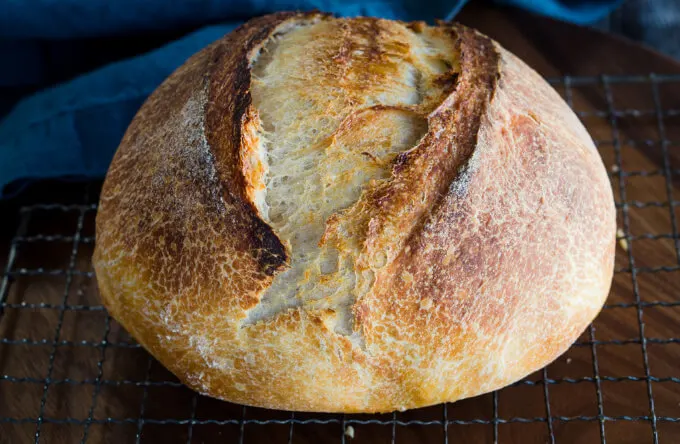
Overnight Sourdough Bread recipe is the perfect recipe to learn baking with a sourdough bread starter. Our step-by-step instructions and video will have you creating an amazing loaf of bread at home in no time.
This Sourdough Bread recipe couldn’t be easier to make and it’s a lot quicker compared to other sourdough bread recipes from starters.
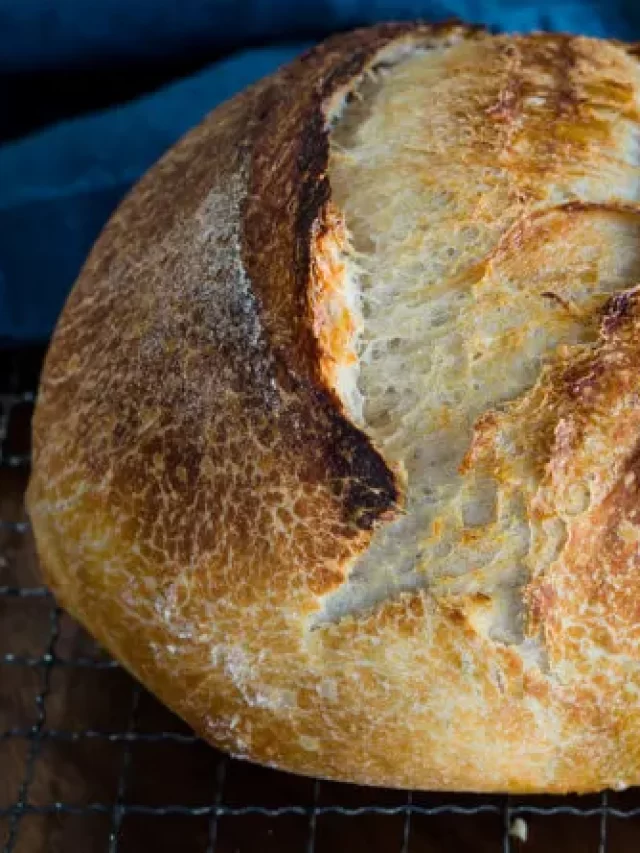
This 500g homemade sourdough recipe has a tender crumb with a slightly sour flavor surrounded by a beautiful crisp crust that has that pull you want in artisan bread.
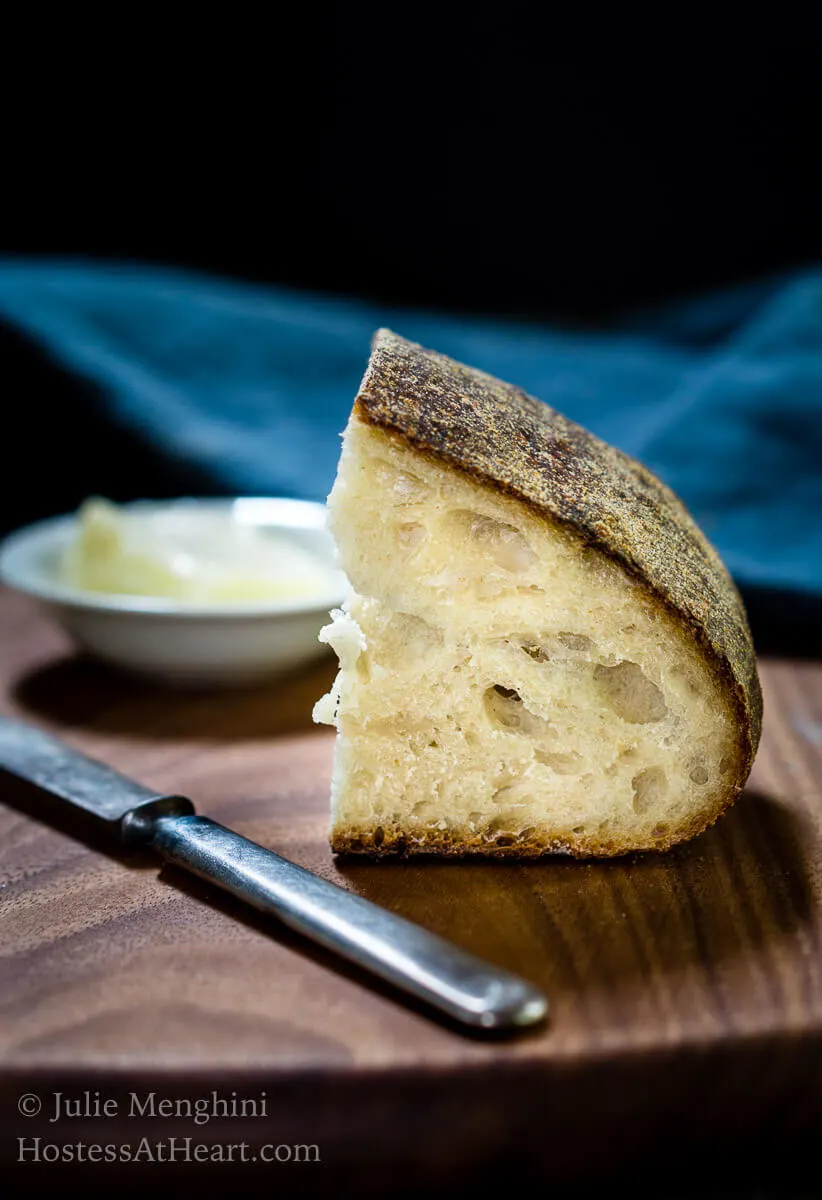
Hello, Julie. Just wanted to say thank you for sharing your overnight sourdough recipe as it really works well for me, a lot of people have shared their methods and this one is simply the best one I have come across so far. So thank you again!”
Kris T
What is Sourdough Bread
Sourdough bread is made by fermentation of dough using naturally occurring lactobacilli and yeast. Sourdough bread has a mildly sour taste not present in most bread made with baker’s yeast and keeps better than other bread due to the lactic acid produced by the lactobacilli. Wikipedia
What is different about sourdough bread?
The difference is in how they are made. Regular bread is made using store-bought yeast that reacts with gluten, making the dough rise. Sourdough bread is made with a “starter“. This starter is made from a combination of yeast and bacteria growing inside a paste made of flour and water.
Make your own starter!
Need help with your sourdough starter? Our Complete Sourdough Baking Guide covers everything from creating a starter from scratch to maintaining it long-term, plus advanced techniques and troubleshooting.
Health Benefits of Sourdough Bread
The fermentation that occurs from using a starter has been shown to lower blood sugar, be easier to digest and can even be tolerated by gluten-resistant individuals.
However, that’s not to say it is gluten-free. Sourdough bread contains higher levels of folate and antioxidants than other bread. Healthline is a very thorough reference regarding the health benefits of sourdough.
Ingredient Tips:

- Bubbly starter – I recommend feeding your starter and letting it sit out at room temperature 4 to 6 hours or until it increases in volume by about 30% and passes the float test.
- If your dough is runny it can be because your starter was actually starving when you used it.
- Bread Flour – Bread flour has a higher protein content than AP flour. That higher protein provides more structure to your loaf.
- If you substitute, they will both be delicious, and the texture will be the same but you may find the loaf made with AP flour balloons out more or doesn’t rise as high.
- Water – There’s a lot of controversy regarding water in bread making. Some experts say if you can drink it you can use it to bake with. Other experts say the chlorine can inhibit yeast activity.
- Mineral content (hardness) can reduce the extensibility (elasticity and ability to stretch) of the dough.
- Salt – I use fine sea salt. It is easier to incorporate and dissolve than a coarser salt.

The above pictures from top left to bottom right.
- The freshly fed starter is thick.
- The Bubbly starter is ready when bubbly and passes the float test.
- 1st quick knead just to combine ingredients (about 1 minute). The dough is thick and heavy.
- 2nd quick knead after a 30-minute rest. The dough is softer and smoother.
- Dough after 8 hours is full of air bubbles.
- Dough after final delicate kneading is smooth and silky.
Absolutely! We love adding dried fruit such as apricots or cranberries, chopped nuts, cheese, olives, or herbs such as rosemary or thyme.
We recommend that you start by adding no more than 20%. So for this 500-gram loaf that would be
500 x 20% = 100 grams. You shouldn’t have to adjust your baking time.
Be careful that you don’t add a lot of moisture. Semi-hard cheeses such as cheddar shredded or diced into smaller pieces work well. Drain fresh fruit or olives of excess juice.
Sourdough Baking Guide is a comprehensive resource covering starters, fermentation, shaping, scoring, troubleshooting, and advanced baking methods.
Recipes using a bread starter
- Multi-Grain Wheat Bread Recipe
- Spelt Sourdough Bread
- Sourdough Sandwich Bread using Bread Starter
- Multi-Grain Wheat Bread
- 750gr All-Purpose Flour Sourdough.
Pro tips for Overnight Sourdough Bread
Resting times
Want to save this recipe?
I'd like to receive more tips and recipes from Hostess At Heart!
Don’t let bread rule your life! Here are some resting times that may help you to bake according to your schedule
- Counter rise – Written as is, this recipe has a counter rise of 3 to 8 hours. I’ve shaped it and let it rest in a banneton or you can carefully shape it just before baking it. The rise time is variable. If you have a warm kitchen, it may be ready sooner. Press your thumb into the dough, and if it bounces back slowly, it’s ready to bake. If it bounces back quickly, it needs a little more time to rise. If it stays dented, it’s probably over-proofed.
- Refrigerator proofing – If you don’t choose to bake your bread at the 3 to 8 hour counter proof, we recommend a 90 minute to 4 hour counter proof. Shape the dough and place it seam-side up into a banneton basket or a bowl lined with a kitchen towel that’s dusted with flour. We like dusting ours with a 50/50 mix of wheat flour and rice flour. We’ve actually left our bread in the refrigerator for up to 18 hours with no problems.
- When you’re ready to bake, remove the shaped dough from the refrigerator and let it sit on the counter while your oven preheats. Place it in the dutch oven, score it, and bake as usual.
If you do the full counter proof and then refrigerate the dough, it will be over-proofed. For that reason, try a much shorter counter rise and then refrigerate it.

More helpful tips
- Feed your starter earlier in the day. When it’s bubbly, do the test float. If it’s runny, it’s used up all its energy and needs to be fed again before you can use it. To see if your starter is ready, put a small amount in a bowl or cup of water. If it floats, it’s ready!
- Your bread can be cooked in a cold Dutch oven but I like the color and oven rise I get from preheating my lidded pot.
- To properly bake the bread we rely on an instant-read thermometer. The bread is finished baking when it reaches an internal temperature of 205ºF to 210ºF.
- This bread freezes beautifully. I wrap it in plastic wrap or a ziplock bag and then heavy-duty foil.
- Each time you bake, we keep a notebook and write down anything we do differently such as resting time, baking time, or adding additional ingredients. It’s so difficult to remember what worked the best unless we can look back and see what we were happy about or wanted to do differently the next time. This will also help you to determine what resting times work for you.
YOU MAY NEED
The following are affiliate links. Hostess At Heart is a participant in the Amazon Services LLC Associates Program, an affiliate advertising program designed to provide a means for us to earn fees by linking to Amazon.com and affiliated sites. You can read my full disclosure.
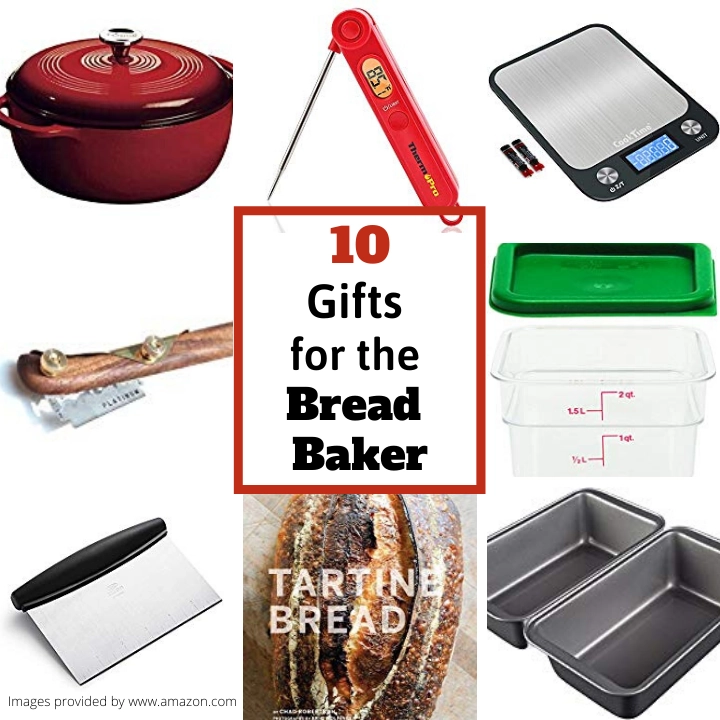
6 Quart Enameled Cast Iron Dutch Oven. – I love this Dutch oven. I have three that are triple the price of this one and it’s my favorite. It bakes my bread perfectly and makes a mean ragu recipe.
Zatoba 1003 Black Walnut Bread Lame Decorative Dough Slasher, 2x2x8 inches – I started out with a lesser quality lame and while this one isn’t expensive it’s definitely better quality and has made a prettier slash in my dough. You can also use a sharp knife.
Instant-read Thermometers aren’t just for meat! I use them to know when my bread is baked. I bake until I get an internal temperature of 205º F to 210º F or anywhere in between.
I have two books (out of several) that I’ve learned so much from. I recommend them exclusively to help in your bread experience. They are easy to read and will help you get that beautiful loaf on the table!
This is a 500gr loaf of bread which isn’t large. Baking bread is all about percentages. If you want a larger loaf, you can adjust the “Servings” in the recipe card and it will calculate your ingredients. (Thank you, Daniel, for this question!)
I hope you enjoyed this delicious recipe as much as we do. Drop me a comment below, and don’t forget to give it a star rating. ⭐⭐⭐⭐⭐. Your comments and ratings help others decide if this recipe is for them too.
Conversions are listed below the recipe card
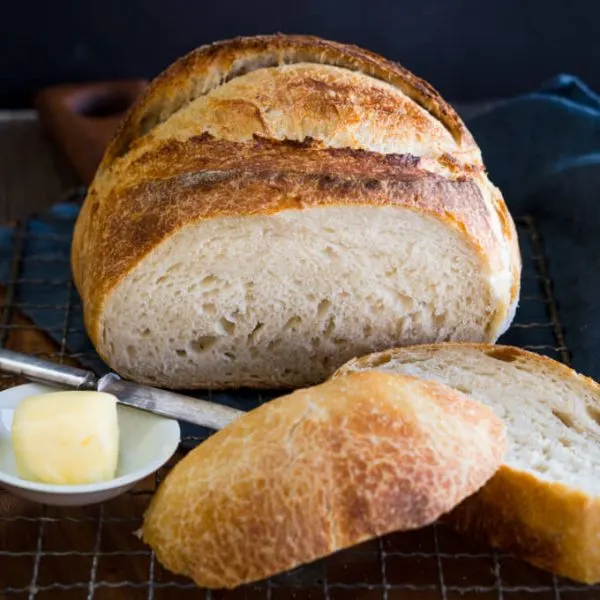
Overnight Sourdough Bread Recipe
Ingredients
- 150 g bubbly starter
- 285 g *purified water or filtered water at room temperature
- 500 g bread flour organic
- 9 g sea salt fine
Instructions
- Squelch all of the ingredients together briefly (just for a minute is enough) with your hand. Cover the bowl with plastic wrap and let the dough rest for 30 minutes.
- Stretch and fold the dough into the bowl several times for about a minute. Cover and leave it out on the counter overnight, 6 to 8 hours. In the morning it will have doubled in volume at least.
- Pre-heat the oven to 475 °F (240/250C) (I preheat to 475°F and place your lidded pot inside to heat up. You can use an enamel Dutch oven or aluminum roaster. You can also put the dough into a cold pot.
- Dust your counter with flour. I use a rimmed baking sheet lined with parchment paper and then dusted with rice flour. It makes it easy to pick up the dough. Scrape the dough out onto the counter. Don’t punch it down. You want to keep as many of those bubbles as you can.
- Pull the outside thirds into the middle and shape as you wish. Try to pull the outside of the dough as tightly as possible so it will hold its shape well. I shaped mine into a ball also known as a boule.
- Cover with some oiled plastic wrap loosely. Allow the dough to rest for 30 minutes. Set the timer as this is the only proofing that should NOT be overdone.
- Remove the plastic wrap and slash with a sharp knife or lame.
- Carefully remove the pot from the oven and remove the lid. Carefully place the dough into the pot. I lift mine by the edges of the parchment paper and put the whole thing into the pot. Replace the lid and place in the oven.
- Reduce the heat to 425 °F 220C (425°F convection). Bake for 20 minutes. Remove the lid and bake for an additional 20 to 25 minutes or until the internal temperature reaches 205 °F ri 212 °F when tested with an instant-read thermometer.
- Immediately remove from the pot and cool on a cooling rack completely before slicing.
Video
Notes
- If you want to mix bread earlier in the day. After rising for 90 minutes or up to 4 hours at room temperature, shape and set the covered dough in the refrigerator to bake the next day. Remove the dough from the refrigerator to sit out while the oven preheats.
- Feed earlier in the day. When it’s bubbly do the test float. If it’s runny it’s used up all its energy and needs to be fed again before you can use it. To see if your starter is ready, put a small amount in a bowl or cup of water. If it floats it’s ready!
- Your bread can be cooked in a cold dutch oven but I like the color and rise I get from preheating my lidded pot.
- This bread freezes beautifully. I wrap it in plastic wrap or a ziplock bag and then heavy-duty foil.
Nutrition
Nutritional Disclaimer
This recipe was calculated using the exact brands and measurements I used to make this recipe. If you are following a strict diet please note changing anything will cause the nutritional info to change. My calculations are intended as a guide only.
Conversions for Overnight Sourdough Bread recipe
We realize that many of you aren’t comfortable using a scale. The closest conversions are the following.
- 4 cups flour
- 1 1/4 cup water
- 2/3 cup starter
- 1 1/2 tsp salt
A disclaimer is that I’ve never made this recipe without weighing the ingredients so I can’t guarantee or possibly troubleshoot any problems you may have with the recipe.
If you like this recipe you may enjoy these too
- Homemade Crusty Bread recipe
- 6 Ingredient Simple Classic Italian Bread Recipe
- Soft Buttermilk Sandwich Bread
- Simple Ciabatta Bread Recipe – Made 2 Ways!
- Spiced Apple Star Bread
This bread was made possible by the resources and recipes shared by Elaine, Selma, and Celia! Please visit all three of these blogs for amazing bread information!

Did you enjoy this recipe? Don’t forget to pin it for later and follow me on Pinterest for more delicious recipes like this one!




I started 6 years ago doing sourdough with your overnight recipe which turned into a very big sourdough business! I bake up to 120 loaves per week now. So glad I never gave up even when I had issues with my starter or my bread didn’t turn out well. Your recipe is also the one I recommend for all the lovely people who buy my dehydrated starter. I tweaked the recipe over time to make it work for my needs, added cold fermentation, reduced starter, increased amount of water and played around with flavours. I now offer 20 different flavours. Thanks so much for sharing your recipe!
You are very welcome. I am happy for you and wish you the very best in your business endeavors.
I adore this recipe – so much less faff than the others ones I found online and I love the bread it makes (I couldn’t count how many times I’ve followed this recipe!)
If I wanted a larger loaf, is it possible to increase all ingredients by eg. A quarter? Or do you think that would mess it all up!
Thank you, Rach! I’m so glad it works for you. You can use the measurements in this recipe for a larger loaf: https://hostessatheart.com/homemade-sourdough-bread/. Using this overnight recipe that works for you, just don’t split it in half. You can make one 1000 gram loaf. Let me know how it goes!
This bread was so easy to make and delicious. Could I make it into a caprese style loaf with pesto, mosserella cheese and oven dried tomatoes? If so when would I add inclusions?
Great question, Sarah! Absolutely! We love adding dried fruit such as apricots or cranberries, chopped nuts, cheese, olives, or herbs such as rosemary or thyme.
We recommend that you start by adding no more than 20%. So for this 500-gram loaf that would be
500 x 20% = 100 grams. You shouldn’t have to adjust your baking time.
What temp/time do you recommend for an open bake?
Since you aren’t using your oven as a steam oven, you can preheat and bake at 425F.
I’m new at this and finally had the best luck with this recipe! Loving my breads. So this time I want to make 2 smaller loaves. What temperature should they bake? I only have one Dutch oven so I’m going to use a cast iron skillet and cover it with another pan and hope it works. We shall see. I’m guessing maybe bake the two smaller loaves at 350?
Hi, Kerry! Congratulations on your sourdough journey! Actually, I wouldn’t change the temperature but check them sooner after you’ve removed the lid (10 to 15 min) and check the temperature with an instant read thermometer – the bread is finished when it hits an internal temperature of 205°F to 210°F. Using a cast iron skillet will work. A few tips to make it work well:
1. Make it as tight as possible. The more steam that stays in, the better. If your covering pan is wobbly or has gaps, you can tent some foil around the edges to help seal it.
2. Preheat the skillet too, just like you would a Dutch oven, so the bottom of the bread gets a nice crust right away.The whole point of using a dutch oven is to catch steam so you’ll want to make sure that your cast iron skillets seam together tightly. if steam escapes a lot, your crust might not be as crackly and the loaf might spread out a bit more than it would in a Dutch oven. But the bread will still taste amazing!
Lastly, you can always bake them separately using the same dutch oven.
Hope this helps! Stop back and let me know how it goes.
I baked it before I saw your reply. I did heat the cast iron skillet in a hot oven but not the lid (a big metal pan). I need to invest in something better for scoring the dough. My score didn’t really come through. The bread was OK but the Dutch oven loaf came out much puffier and fuller. I’ll try sealing it next time, or I’ll invest in another Dutch oven and a scoring device!
Scoring sounds simple but it isn’t always. I’ve found that wetting the razor blade helps it glide through the dough. For a detailed article on sourdough check out my guide. It goes into detail and is always being updated.
What temperature C do you suggest using for and air oven please?
Hi, Lou! Preheat the oven to 240/250C and reduce to 425 °F 220C when you put the bread into the oven. It will explain it in the recipe card but please let me know if you have any questions.
Thank you